

CONSTRUCTIONAL FEATURES : SELVAGES
The standard edging for frictionally driven woven wire belts is either the Knuckled or the Welded selvage. However, certain installations require special edges. Illustrated are several of the optional selvages that are available. For greater strength and stability at the edges of the belt, Filled, Duplex or Double Woven, Knuckled and Welded, or Rod Looped selvages may be used. The Rod Looped selvages are extremely strong, and is not welded;
therefore, it is a good selvage for use under stress and at high temperatures. The Ladder selvage provides smooth edges, as well as strength and is also efficient at high temperatures. This selvage may also be welded for additional strength. For CONVENTIONAL and BALANCED belts, Mesh Tech furnishes special collapsible edges which permit the belt to slacken for quick and thorough cleaning, to ease maintenance and meet sanitary requirements.
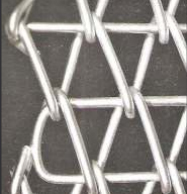
Knuckled Selvage
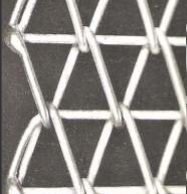
Welded or Brazed Selvage
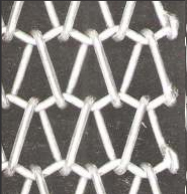
Knuckled & Welded Selvage
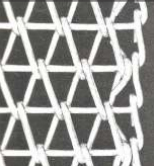
Ladder Selvage
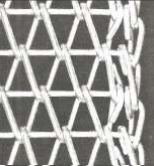
Rod Looped Selvage
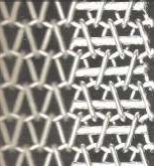
Rod Filled Edges
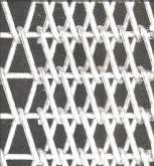
Duplex Edges
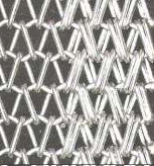
Double Woven Edges
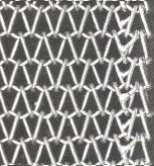
Collapsible Edge for BALANCED Belts
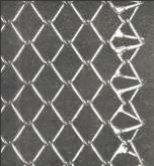
Collapsible Edge for CONVENTIONAL Belts
CONSTRUCTIONAL FEATURES : RETAINING EDGES
To contain a depth of material or to handle products which might roll off a belt, retaining edges may be specified. Troughing of the belt is not usually practical, since Metal Mesh Conveyor Belt are driven on straight faced pulleys. Retaining edges may be extensions or modifications of the belt fabric, or may consist of guard plates which are attached to the belt. In selecting retaining edges with portions of the fabric turned up, careful consideration must be given to the drum size. Since the flaring of the fabric edges is limited, larger diameter drums are normally required.
Generally higher and stronger than the retaining fabric edges guard plate edges are used when the material lies relatively deep on the belt, and is of such nature that a solid retaining edge is necessary. Shingle Guard Plate Edges will permit a reverse bend as the belt travels around the pulley. The other types of plate edges may be selected when a reverse bend is not required and when a stronger edge is needed, or to obtain an edge that butts closely to the belt selvage.
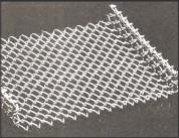
Turned-Up Fabric Edge
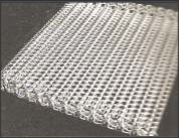
Relieved & Reintegrated Turned-Up Fabric Edge
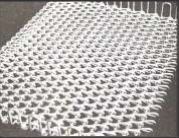
Looped Edge (Staple or Wicket)
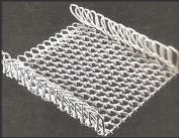
Interlocking Looped Edge (Telescope)
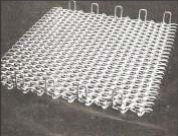
Looped Edge (Modified)
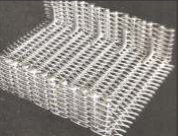
Elongated Spiral Edge (Reinforced)
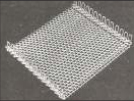
Hairpin Extension Guard Edge
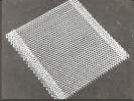
Coil Spring Guard Edge
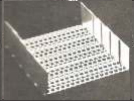
Shingle Guard Plate Edges (Reverse Bend)
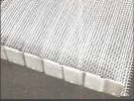
Offset Guard Plate Edges
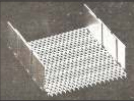
Staggered Guard Plate Edges
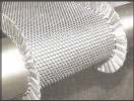
Interlocking Guard Plate Edges (with Lug Attachment)
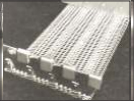
Stabilized Guard Plate Edges
CONSTRUCTIONAL FEATURES : FLIGHTS AND DIVIDERS
Woven wire conveyor belts will move products on an incline of ten to twenty degrees, depending upon the load to be handled. If the angle of inclination is greater than the maximum incline for the particular product, flights must be used on the belt. The design and height of the flights depend upon the material being conveyed. Flights are also used to carry material through liquids, in washing and cooking operations.
To separate products of different sizes, or several products which are being processed on the same belt, dividers are used. Like guard plate edges, Mesh Tech plate dividers provide height and strength. Coil dividers separate light and fragile materials, and materials which lie shallow on the belt.
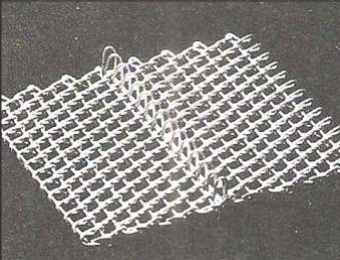
Single Spiral Flight
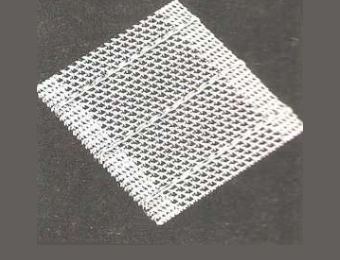
Crimped Rod Flight
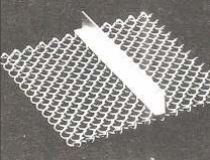
Angle Flight
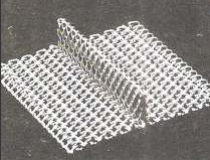
Fabric Flight
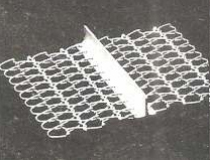
Tee Flight

Picking Flight
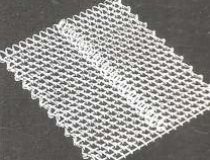
Coil Divider
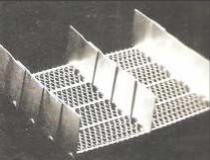
Plate Divider
CONSTRUCTIONAL FEATURES : SPECIAL COVERINGS
Mesh Tech woven wire belts may be Teflon coated to provide a non-stick surface for processing products which might adhere to the belt. At temperatures from -200° to 400°F, Teflon coated belts find wide application in the food processing industry. COMPOUND BALANCED specifications may be impregnated with silicon rubber to create for handling hot particles. This construction is widely suited for conveying hot sinter and ores, light aggregates and similar products under conditions too rugged for rubber belting.
Architects and designers are utilizing plastic coated belts or metal mesh in decorative schemes in modern buildings as room or patio dividers, balcony or stair railings and protective barriers. The possibilities for plastic coated mesh are unlimited.
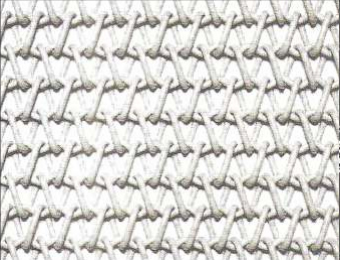
Teflon Coated
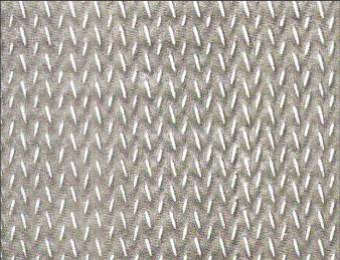
Silicon Rubber Impregnated
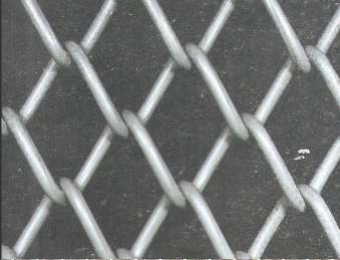
Plastic Coated